
The Buddha famously described our easily distracted mind as the “monkey mind”. If this was the state of affairs 2500 years ago, how much more so now!
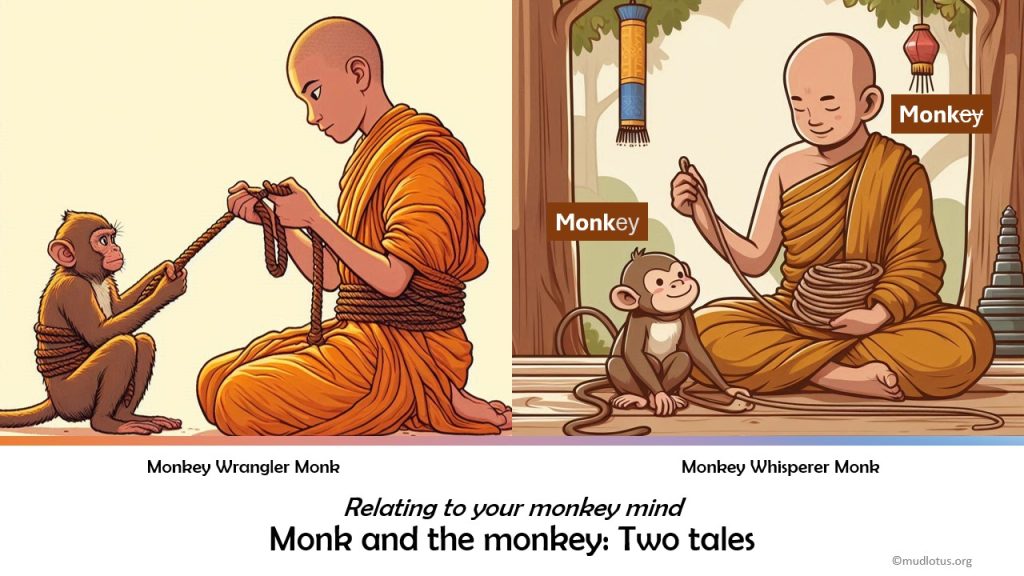
To deal with this “monkey mind” that causes so much havoc, here’s a tale of two monks, illustrating two distinct approaches.
The Monkey Wrangler monk tries to control and subdue the monkey through sheer force, but every forceful action provokes the monkey to fight back with equal and opposite resistance. While the wrangler might eventually coerce and control the monkey, doing so takes great effort and leaves behind a residue.
The monk may think that the monkey mind has been subdued, but what’s hidden is the controller mind that wants to coerce and subdue. This can be let go later, but often, it is so invisible that the monk doesn’t even recognize it is there. And even worse, the coercer-controller mind creeps out in how the monk relates with others, which can prove disastrous when coupled with the unawareness.
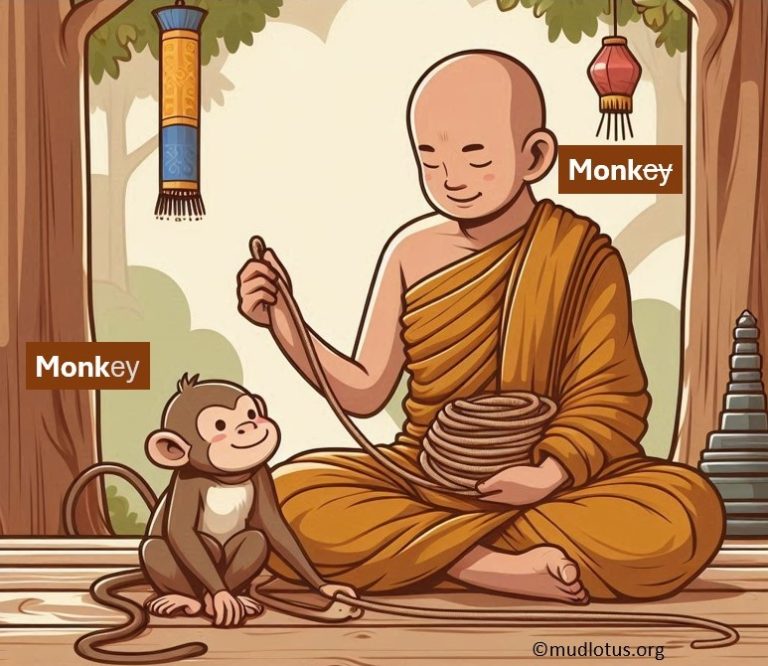
Contrast this with the Monkey Whisperer monk. This monk understands where the monkey comes from because he’s been there, done that (being a monkey). The Monkey Whisperer recognizes the “monk” inside the monkey. He sees that all of the monkey’s leaping about is because the monkey doesn’t get itself, doesn’t recognize the monk in the monkey.
In the monk’s wide-open, compassionate and understanding presence, the monkey naturally settles down. All the monkey really needed was for the monk to recognize its true nature so that it can do so too.
The monkey trusts the monk enough to be known in its entirety. In this mutual knowing, the monkey is no longer a monkey and the monk is no longer a monk.
The knowing dissolves all separation between ‘monk’ and ‘monkey’ until there’s:
Just the Buddha mind.
Just this.
Just •
•
Sentha Sivabalan teaches the Monkey Whisperer Way because it does not introduce the faults of control and coercion or the resulting consequences of rebellion and resistance. It does require wise relating with tender-hearted understanding–but this turns out to be excellent in the beginning, excellent in the middle and excellent in the end.
The Monkey Whisperer Way is how Sentha presents the Third Turning of the Buddha’s Dharma wheel. These are the teachings of Buddha Nature, our inherent awakened nature that we only have to recognize, not create from scratch. While these third-cycle teachings are common to Chan, Zen and Tibetan Buddhism, glimmers of this approach can be found in texts from Early Buddhism, like the Luminous Heart Sutta.
Wise relating with tender-hearted understanding is Right View from the perspective of the Third Turning applied with Great Compassion which includes all four Brahma Viharas.