
Contents
The Richness of the Pali (and Sanskrit)
Exploration: For the Intellectually Inclined
Instructions: For Practitioners
The Luminous Heart Sutta
The Finger Snap Chapter in the Anguttara Nikaya (AN1.51-55)
Also known as the Pabhassara Citta Sutta, Pabhassara Sutta, or Luminous Mind Sutta
translated from the Pali by Sentha Sivabalan
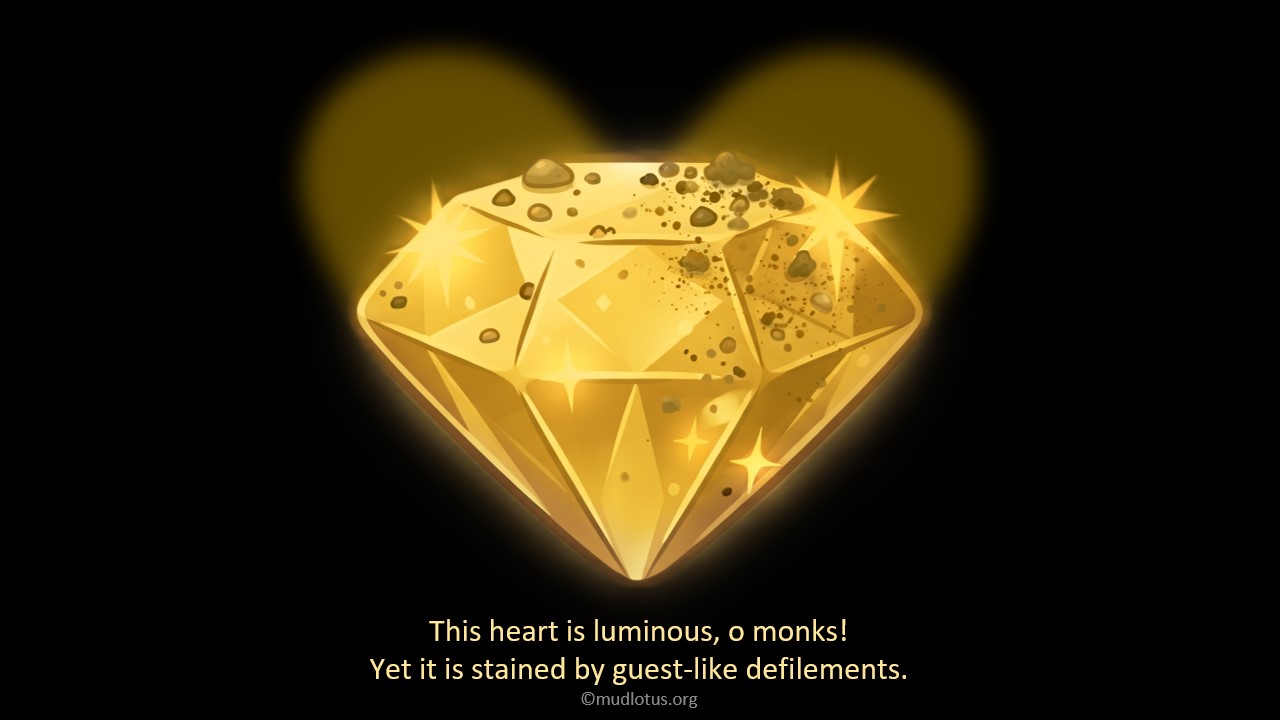
This heart1 is luminous2, o monks!
Yet it is stained by guest-like3 defilements4.
The ordinary person who has not heard the teachings does not clearly know5 this as it is6.
Therefore, for the uninstructed ordinary person, there is no cultivation of the heart7.
This heart is luminous, o monks!
And it is freed from guest-like defilements.
The noble disciple who has heard the teachings clearly knows this as it is.
Therefore, for the instructed noble disciple, there is cultivation of the heart.
If only for one finger snap, a monk approaches again and again8 the tender heart9,
He is called one who does not lack jhāna, one who carries out the teacher’s instructions,
One who is responsive to advice, one who eats not in vain.
How much more so, those who do this a lot!
If only for one finger snap, a monk brings into being10 the tender heart,
He is called one who does not lack jhāna, one who carries out the teacher’s instructions,
One who is responsive to advice, one who eats not in vain.
How much more so, those who do this a lot!
If only for one finger snap, a monk keeps in mind11 the tender heart,
He is called one who does not lack jhāna, one who carries out the teacher’s instructions,
One who is responsive to advice, one who eats not in vain.
How much more so, those who do this a lot!
The Richness of the Pali (And Sanskrit)
- citta: heart or heart-mind. The Western notion of mind is often correlated with the head, so heart is a better one-word translation. ↩︎
- pabhassaram: luminous.
In Sanskrit, prabhāsvara: clear, radiant, resonant, brilliant, clear light, luminous, shining forth
pra = sense of moving out
bhā = radiance
svara = sound, voice
So, this is not a passive quality. ↩︎ - āgantuka: Guest-like. The traditional translation is “adventitious”, which doesn’t convey as clearly the ‘of the nature of coming and going’ aspect of āgantuka. ↩︎
- upakkilesa: surface defilements. In Sanskrit, klesha: patterned reactions ↩︎
- pajānāti: clearly knows. This is the same root as in sampajañña: clear comprehension ↩︎
- yathābhūtaṁ: as it is, as it really is ↩︎
- cittabhāvanā: cultivation of the heart. bhāvanā means becoming. It is practicing until there is no separation from what is practiced towards. ↩︎
- āsevati: approaches again and again. ā: near, towards. sevati: associate with, pursue, frequent, practice, engage with as an act of service. ↩︎
- mettācittaṁ: literally, a heart of loving kindness and friendliness (maitri). I’ve translated this as the tender heart following Dzigar Kongtrul Rinpoche who says that the Tibetan word for metta is tsewa, and that he prefers to leave untranslated or translated as ‘tenderness’. He says:
“The tender, open heart of tsewa is an infinitely malleable resource. It expresses itself as kindness, compassion, vicarious joy, generosity, tolerance, mental clarity, courage, resilience, unshakeable cheerfulness, and in many other internal ways. It also manifests outwardly in our positive actions. Everything we do for the benefit of others, or for the sake of opening our own hearts, comes from this fundamental quality of tsewa. In this way, tsewa is really the source of all goodness in the world. (Page 5, Training in Tenderness)”
So, mettācittaṁ when translated as the Tender Heart encompasses all four Brahma Viharas (Compassion, Appreciative Joy, Loving Kindness and Equanimity) and is the incomparable doorway to awakening. ↩︎ - bhāveti: brings into being. The same root as bhāvanā: becoming, practicing until there is no separation from what is practiced towards. ↩︎
- manasi karoti: keeps in mind. Attends to (wise attending to the source is yonisomanasikāra). Literally, “makes in his mind”. The Burmese translation for manasikaroti amounts to “Keep it in your mind, fill it in your heart.”–this is the spirit of the instruction in this paragraph. ↩︎
Parallels from Mahayana
Is this sutta from Early Buddhism an inspiration for the Buddha Nature teachings of the Third Turning of the Dharma Wheel?
For the Mahayana side of the story, see how closely this sutta resembles verse 1.63 from the Uttaratantra. The words are almost the same.
The luminous nature of the mind
Is completely unchanging, just like space.
It is not afflicted by adventitious stains,
Such as desire, born from false imagination.
~When the Clouds Part, Brunnhölzl, 376
Instead of the citta being prabhāsvara, it is the nature of the citta that is prabhāsvara. The klesha defilements/stains are āgantuka, guest-like–just as in the Luminous Heart Sutta.
Exploration: For the Intellectually Inclined
For the Theravada side of the story, see Thanissaro Bhikkhu’s comments and Bhikkhu Sujato’s comments.
Note that the Uttaratantra does not claim that there’s no purification to be done. In both perspectives, the luminous heart can be used as a resource in this purification.
According to Ajahn Maha Bua (see Mae Chee Kaew’s biography, page 194), the luminous heart is only clear of surface defilements. When surface defilements have been seen through, he cautions against missing the entrenched ignorance that can be bound up in the luminosity.
This entrenched ignorance is the nescience entrenchment that Queen Srimala Devi’s Sutra cautions about. The luminous nature of mind mentioned in the Uttaratantra, however, is not a luminosity bound up with entrenched ignorance. It is a luminosity that is unchanging and therefore not the luminosity of subtle changes that Ajahn Maha Bua refers to.
So, when examined, the Theravada and Mahayana takes on the luminous heart do not contradict each other–they just refer to different aspects of the citta. The Theravada luminous heart is the citta freed of all defilements except entrenched ignorance. The Mahayana luminous heart is the citta beyond all defilements including entrenched ignorance–one that can serve as inspiration and as a resource for practices that aim to advert directly to it.
Instructions: For Practitioners
- Trust in the Luminous Heart
- It’s always and already there, for practioners and non-practioners alike. Says the Buddha. So begin your practice with this trust.
- Know that all defilements are guest-like.
- So treat them as guests. Let them be “free to come, free to stay, free to go,” as I phrase it in Tender-hearted Understanding.
- Paradoxically, the “free to come, free to stay” is a requirement for them to be “free to go”.
- “Let the essential be the essential and the incidentals be the incidentals,” also a phrasing from Tender-hearted Understanding.
- The essential here is the Luminous Heart.
- The incidentals are the defilements in all of their forms and gradients: Greed and desirous attachment, Hatred and aversion, Ignorance, Envy, Pride, …
- The above two are the very basis of practice or cultivation of the Heart.
- Know this “as it is”.
- And really, knowing ‘what is as it is’ is what all of practice is about.
- All the Buddha is asking of you is to practice the Tender Heart. And for just a moment as long as the snap of your fingers. So do this in the three stages he recommends:
- Approach the tender heart again and again with an attitude of service.
- Bring into being the tender heart.
- Keep in mind the tender heart and let it fill your whole being until it is all that there is.
- If you do this, then you’d be a practitioner worth your salt.
- You will not be a stranger to the beautiful and essential meditative absorptions called the Jhanas. Because that last instruction to keep in mind the tender heart until it fills your being is in itself an entry point for the Jhanas.
- You would’ve heeded the Buddha’s advice.
- If as you do this practice, there’s an experience of just the luminous heart
- And there’s still something moving, this is the luminous heart that is still bound up with entrenched ignorance. Follow Ajahn Maha Bua’s instructions and go beyond the bound-up entrenched ignorance. Or hear the Buddha’s admonishment to Ananda in the Shurangama Sutra, “That is not your mind, Ananda!”
- If there’s just the unchanging, the unborn, the uncreated–well, hey!
- Afterwards, still follow the Buddha’s instructions in the Shurangama Sutra, Volume 8 on the Fifty Demonic States: Don’t make a big deal of it. If you don’t think you’ve achieved something, then this is a good indicator of your practice–keep going. If you make a big deal out of it, then the Shurangama Sutra cautions you that it becomes an invitation to a demonic state.