Zoom Series + Optional In-Person Retreat
Even in the midst of our messy worldliness, our inherent nature is pristine and unsullied. Trusting in, reconnecting with and functioning from this always and already present inherent nature is the swiftest path of awakening.
Our inherent awakened nature
When your own mind takes refuge with your self-nature, it takes refuge with the true Buddha.
Hui Neng in Dharma Jewel Platform Sutra

In this course, we will explore awakening to our inherent nature through the Buddha’s third turning (Buddha nature / tathagatagarbha) teachings. These teachings are simple, direct, and profound.
Short guided meditations will invite direct experience that cuts through delusion. Bite-sized experiential explorations will help develop trust in the third turning view of the ultimate refuge: our own inherent awakened nature. With this trusting—along with cultivating the tender heart of awakening (bodhicitta) and stable, embodied attention—view can mature into realization.
Five Wisdom Buddhas
To study the Buddha Way is to study the self.
To study the self is to forget the self.
To forget the self is to be actualized by myriad things.
Dogen
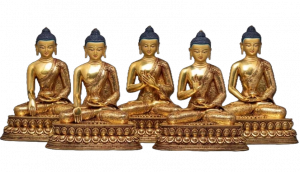
In the longer Saturday sessions, we will explore five skillful archetypes of awakening from delusion: the Five Wisdom Buddhas.
Using guided practices and breakout rooms, we will hold the five flavors of our delusions in compassionate clarity so that they can dawn as the five wisdoms symbolized by the five wisdom Buddhas.
Beginners Welcome!
This course will streamline practice for long-time practitioners and introduce the cultivation of embodied, warm-hearted, clear, open awareness to beginners.
Recommended, but not required reading
Our guide in this course will be the Ratnagotra Vibhaga Mahayana Uttaratantra Shastra, which translates as “The Final Teaching of the Mahayana, A Treatise Analyzing the Source of the [Three] Jewels.” This treatise is a direct pointer to our jewel-like pristine birthright, our inherent awakened nature. Considering the length of its title, this work goes by many shortened names—the Ratna, the Uttaratantra, Ratnagotra Vibhaga, Uttaratantra Shastra. This precious teaching is the final of five revealed by Maitreya, the future Buddha, to Asanga. It’s said to be the condensation of 10 Buddha Nature sutras.
Our root text is significant enough to have many translations and commentaries. Here are some recommendations:
- Most accessible book: The Uttara Tantra: A Treatise on Buddha Nature by Thrangu Rinpoche
- Most comprehensive book: When the Clouds Part by Karl Brunnhölzl
- A good mix of accessible and comprehensive: Buddha Nature: The Mahayana Uttaratantra Shastra by Khenpo Tsultrim Gyamtso Rinpoche
- On the web in English, French, Sanskrit, Chinese and Tibetan: Tsadra.org
Course Schedule
- January 14, 2025-July 8, 2025 (~30 meetings with 2 weeks off in April)
- Wednesdays, 6:00 pm – 7:30 pm PDT (Jan 14 – Jul 8)
- 3rd Saturdays of the month, 9:00 am -12:00 pm PDT (Jan 17, Feb 21, Mar 21, Apr 18, May 16, Jun 20)
- While attending through Zoom will allow for the most interaction, recordings will be available if the timings do not work with your schedule. Teacher<->student interaction is an important element of this course. If you plan to catch most sessions through recordings, we will sync through email.
Retreat at the Mt. Baldy Zen Center
- 9 days: Friday, July 24 to Sunday, August 2
- Room and board: ~$90/night
- Retreat registration opens in February
About Sentha
Sentha has 20+ years of experience in studying, practicing and teaching meditation in all three current streams of Buddhism: Chan (Japanese: Zen) Buddhism with Gilbert Gutierrez, Tibetan and Theravadin Buddhism with Marvin Treiger. She also has taught 5 year-long courses in Compassionate Communication and Presence based on Non-Violent Communication. Her interest, understanding and study of trauma resilience (TRM Level 1 Training, Dec. 2015, at Trauma Resource Institute) informs her approach to teaching.
Sentha’s teaching style invites and evokes direct experience of what is being taught, so that you can ehipassiko, come and see for yourself. She teaches the buddhayana (Buddha Vehicle) / ekayana (One Vehicle) in the syncretic spirit of Early Chan. She is committed to meeting and honoring students where they are to point out what’s intrinsically and already present.