Dhyana and Prajna Paramitas
Transcendence of Meditation, Transcendence of Wisdom
Workshop series recordings + Zoom consultations
The Paramitas
In Mahayana, the big boat that ferries all beings to the other shore, the Six Paramitas define practice.
Paramita simultaneously means both perfection and going beyond or going to the other shore, making transcendence a good English equivalent.
Of the six paramitas, dhyana (meditation) and prajna (wisdom) are key. Where dhyana sets a stable base from which prajna can arise, prajna is the glowing sword that sublimates obscurations by simply illuminating what is.
When these two transcendences are practiced, the other paramitas–virya (inspired effort), kshanti (patience), sila (ethical conduct), and dana (generosity)–cannot but co-arise.
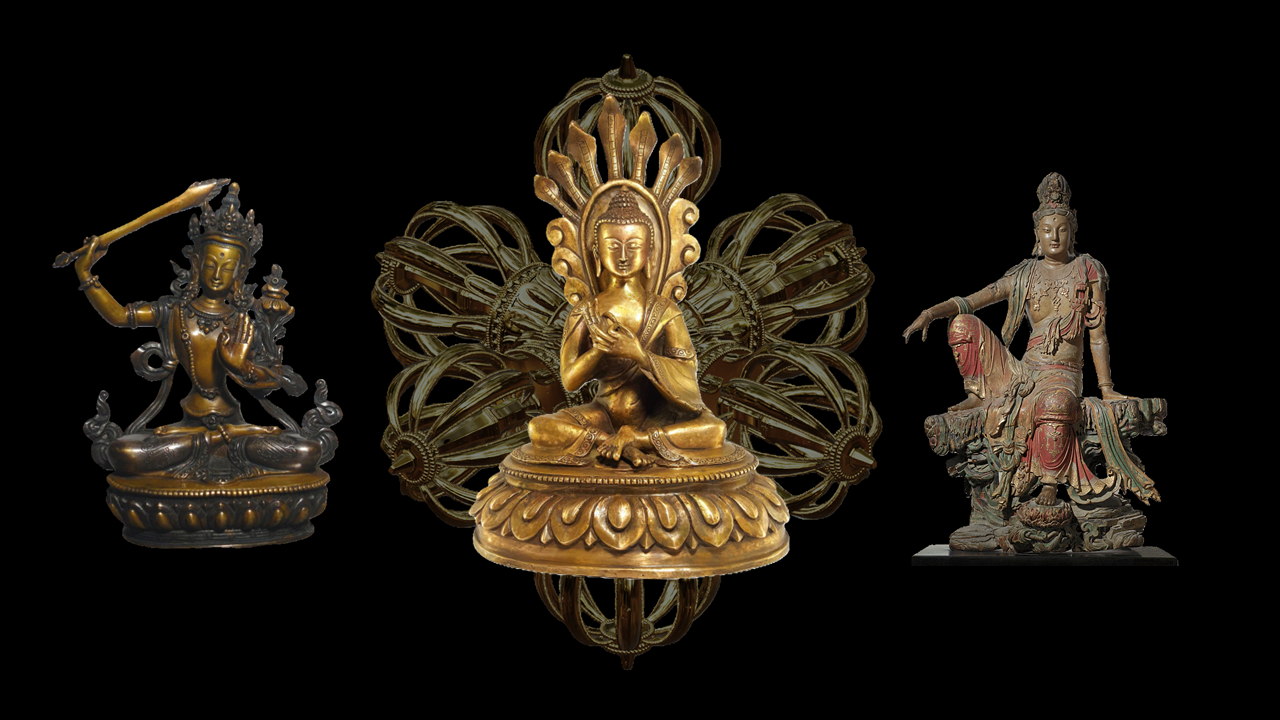
In this exploration, Nagarjuna will be our guide, Manjusri and Guan Yin, our exemplars. Our exploration will span and transcend Shamatha (samatha) and Vipashyana (vipassana).
Contents of this course
- 32 recorded sessions with 91 guided meditations
- 3 1-on-1 Zoom consultations
- Email consultation as needed.
Cost
Tiered pricing for the workshop series:
- Basic: $300
- Sponsor: $400
- Supported: $200*
*If this is not comfortably affordable, e-mail Sentha. No one will be turned away based on cost. Work-study options are available.
Learn more about this course
Read on to know more about this course.
Dhyana/Jhana Paramita: Transcendence of Meditation
Nagarjuna defines the practice of Dhyana Paramita as the practice of the dhyana (Jhana) absorptions accompanied by Great Compassion.
The Jhanas are deeply restorative meditations that form the easy path the Buddha taught to most of his students. They are the very definition of Right Concentration, one of the Eight-fold Path, in foundational Buddhism (shravakayana). When accompanied by Great Compassion, they are the very definition of dhyana paramita, one of the six paramitas of Mahayana.
Jhana practice, when guided by a well-knowing advisor, incorporates insight at each step. In this course, we will explore a Mahayana approach to the Jhanas.
Sentha teaches the Jhanas in a very accessible way with pointing out instructions that open up parajhanic states at the gateways to each Jhana. These gateways are very conducive to insight and are the practice platforms (bodhimandas) for Bodhisattvas on the ten Bhumis. Parajhanic states are accessible to all and have the potential to deepen into the full Jhana in a retreat setting, with prior Jhana experience or with trusting and interested practice.
The fruition of the transcendence of meditation is the actualization of the non-meditation of Mahamudra, the open presence of Dzogchen, the Silent Illumination of Chan.
Mahakaruna: Great Compassion
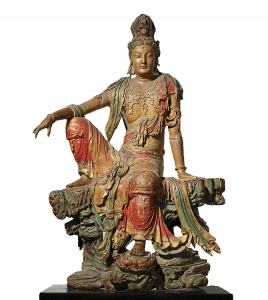
Great Compassion is the open secret of Mahayana. It heart-fuels and heart-orients practice, effortlessly lassoing in virya (inspired effort), kshanti (patience), sila (ethical conduct), and dana (generosity), the other four transcendences.
While Jhanas are the pinnacles of stable attention and nondistraction, Great Compassion is the pinnacle of heart-opening. The practice of Great Compassion will rope in the other three Brahmaviharas (Supreme Abidings): Appreciative Joy, Loving Kindness and Equanimity.
Prajna Paramita: Transcendence of Wisdom
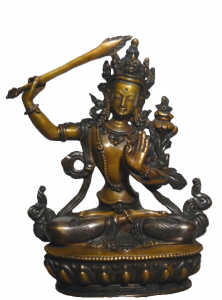
Prajna can be translated as primary knowing in both senses of primary as original knowing and supreme knowing. The supreme knowing is the knowing of what is, in a way that has already and always has been available. Prajna is clear knowing without fixating on the fluctuating, the insubstantial, the superficially differentiated, the mistaken.
Sentha teaches prajna experientially, covering Right View from the perspective of all three turnings: dismantling the illusions of permanence, singularity and non-interdependence from the early Buddhist perspective; investigating the emptiness of self and other from the Madhyamaka perspective and recognizing the already perfect nature from the tathagatagarbha perspective.
The Chan practice of non-discursive inquiry, Hua Tou, will be our tool of choice in this exploration.
The fruition of the transcendence of wisdom is non-abiding, non-dwelling, free and empty flow of awareness.
Dhyana and Prajna Paramita

Dhyana practice leads to non-distraction, prajna to non-fixation. The power of prajna is true recognition akin to lighting a lantern in a dark cave, dispelling the darkness of eons. The power of dhyana is like the clear wind guard that keeps the lantern burning steadily.
When the dhyana and prajna paramitas are practiced together, the effect is that of a sustained burning away of the fixations that impede free flow of clear knowing, the coursing through and beyond.
The ultimate result is the wise compassion of Guan Yin and the compassionate wisdom of Manjusri.
About Sentha
Sentha has 20+ years of experience in studying, practicing and teaching meditation in all three current streams of Buddhism: Chan (Japanese: Zen) Buddhism with Gilbert Gutierrez, Theravadin and Tibetan Buddhism with Marvin Treiger. She also has taught 5 year-long courses in Compassionate Communication and Presence, based on Non-Violent Communication. Her interest, understanding and study of trauma resilience (TRM Level 1 Training, Dec. 2015, at Trauma Resource Institute) informs her approach to teaching.
Sentha’s teaching style invites and evokes direct experience of what is being taught, so that you can ehipassiko, come and see for yourself. She teaches the buddhayana (Buddha Vehicle) / ekayana (One Vehicle) in the syncretic spirit of Early Chan. She is committed to meeting and honoring students where they are to point out what’s intrinsically and already present.
FAQ from Chan Practitioners: Is it okay to practice the Jhanas?
Misinformation abounds about the practice of the Jhanas.
Some of this was intentional (see an account on how the Jhanas were suppressed in Thailand and Burma in the book, Jhana Consciousness by Paul Dennison).
Some of this was due to a misunderstanding of the Jhanas as destinations instead of as stepping stones when the Jhanas arise naturally, as often happens in the course of any practice path. This is not surprising because Jhanas are sometimes described as what happens when distractions/hindrances drop away. When Jhanas occur like this, and there is no well-knowing advisor guiding the insight aspect of the Jhana practice and the next steps, the practitioner can get stuck. With the guidance of a well-knowing advisor however, Jhana practice reverts to the easy path to awakening that the Buddha discovered himself, recommended to his students and continued to practice during his lifetime and his parinirvana. To be fair, a practitioner without the guidance of a well knowing advisor can get stuck on any path.
Interestingly but unsurprisingly, one-upmanship between Jhana-practicing schools only contributes to the misinformation.
Typically, resistance to Jhana practice comes from the dry insight and Mahayana schools of today. To further clear up the stigma against the Jhanas, here are some quotes on the Jhanas from Nagarjuna, who is considered a 2nd Buddha in Mahayana schools, as well as from eminent teachers in Chan and Vipassana schools.
Nagarjuna on the Jhanas
Actual wisdom is born of single-minded dhyāna absorption.
When one speaks of “the pāramitā of dhyāna,” all of [the other samadhis and absorptions] are subsumed. Moreover, “dhyāna” is the greatest among them and so is like a king.
[W]hen the bodhisattva practices the pāramitā of dhyāna, the other five pāramitās are all comprehensively assisted in their completion.
Nagarjuna on The Six Perfections, Translated by Bhikkhu Dharmamitra.
Master Sheng Yen on the Jhanas
In Buddhist practice, there are nine levels of samadhi—the first eight constitute worldly samadhi, while the ninth is called nonworldly samadhi. The first samadhi level is the stage of lightness-and-ease. This is also equivalent to the first dhyana level. One proceeds by stages to the fourth dhyana level, and further on until one reaches the eighth level, which is the deepest level of worldly samadhi. Nonworldly samadhi, the ninth samadhi stage, is referred to in Chan as “sudden enlightenment.” It is so called because at the moment of realization, one’s worldview is suddenly transformed from one that is upside down, one that is ruled by suffering and vexation, to one in which one’s bondage to vexation and suffering is released.
So there are two ways of experiencing samadhi. One comes from changing your attitude, where a turn of thought suddenly allows you to experience samadhi. The other kind comes from the step-by-step cultivation through the four dhyanas and eight levels of samadhi. The second way of samadhi is the deeper way. To put it in mundane terms, the first can be likened to being knocked unconscious, and then waking up and not realizing what happened to you. The second is like falling into a very deep sleep without dreams, and then waking up a few hours later and not realizing you had even been asleep.
You may wonder, “Why should I work so hard cultivating samadhi? I may as well get hit on the head or just go to sleep.” The difference is that after regaining consciousness or waking from sleep, one would not experience lightness-and-ease. You would probably be just as prone to irritation as before, and you would probably be subject to the same seductions and distractions. Your character would probably be the same. By contrast, after deep samadhi one will feel great peace of mind and joy. Afterward one would be less likely to respond to negative stimuli or challenges than before.
After experiencing buddha-nature for the first time, one still has habits and propensities that can lead to impure thoughts and impure conduct; greed and aversion may still arise. However, one is at least able to see clearly that one’s mind still cannot completely control the arising of vexations. At that point it becomes very important to practice samadhi.
What then is samadhi? In general, samadhi is the state where the mind is steadily focused on one point and there are no wandering thoughts. There are many levels of samadhi, including some states that are often called samadhi, but are really pre-samadhi states. First there is a feeling of mental pliancy—the mind feels light and at ease. This level can be called shamatha, and is characterized by stillness and calm. The next stage is sometimes called neighboring samadhi, where the mind is intensely concentrated, close to one-pointed samadhi but not yet. While these pre-samadhi and near-samadhi states are useful, the genuine samadhis are the four dhyana levels of the form realm, plus the four dhyana levels of the formless realm.
In practice, the progressive levels of dhyana of the form realm are of greatest interest. They are: (1) relinquishing of unwholesome factors and the appearance of bliss; (2) bliss continues while relinquishing discursive thinking; (3) abatement of bliss as feelings of well-being arise; (4) relinquishing joy for equanimity and clarity of mind.
Things Pertaining to Bodhi: The Thirty-seven Aids to Enlightenment by Chan Master Sheng Yen
Mahasi Sayadaw on the Jhanas
[A]fter having been equipped with pure sīla, one must work hard to attain the states of samādhi and jhāna. It means that one must work for the attainment of all the eight kinds of jhāna or at least one or two of them. This is for disciples of the higher order. If one cannot strive to attain appana jhāna, one must work for attainment of upacāra samādhi or its equivalent khaṇika samādhi. that is, vipassanā samādhi.
Jhānasamādhi is indeed the best to attain, but failing that, one should have acquired khanika samādhi which is equivalent to upacāra samādhi. Otherwise, it is not real vipassanā paññā.
Mahasi Sayadaw in his discourse on the Hemavata Sutta